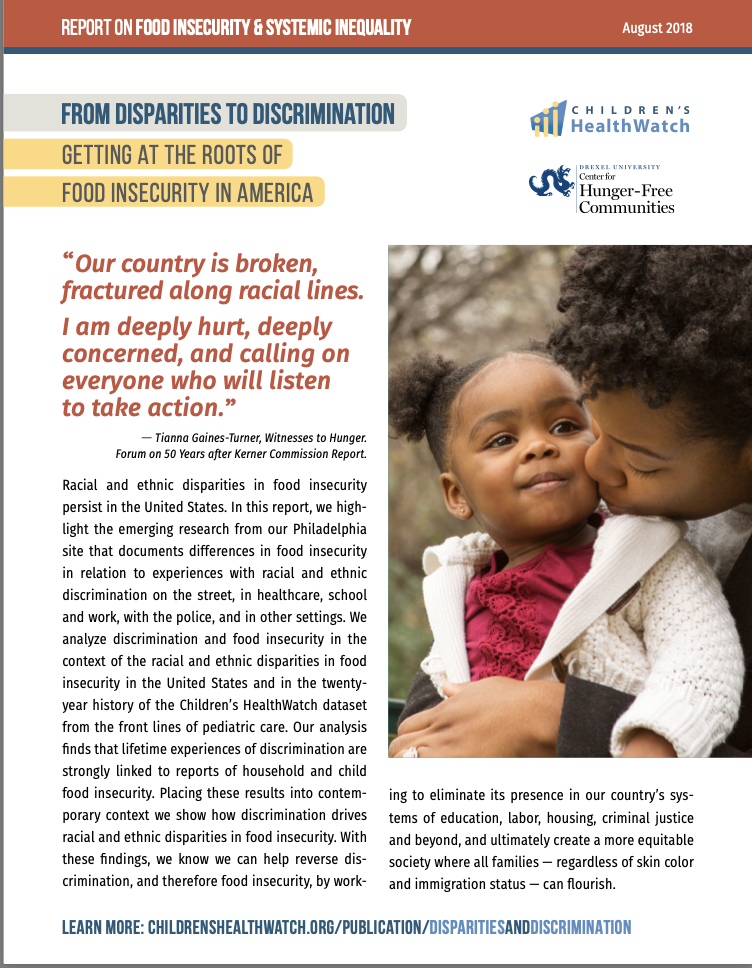
Racial and ethnic disparities in food insecurity persist in the United States. In this report, we highlight the emerging research from our Philadelphia site that documents differences in food insecurity in relation to experiences with racial and ethnic discrimination on the street, in healthcare, school and work, with the police, and in other settings. We analyze discrimination and food insecurity in the context of the racial and ethnic disparities in food insecurity in the United States and in the twenty-year history of the Children’s HealthWatch dataset from the front lines of pediatric care. Our analysis finds that lifetime experiences of discrimination are strongly linked to reports of household and child food insecurity. Placing these results into contemporary context we show how discrimination drives racial and ethnic disparities in food insecurity. With these findings, we know we can help reverse discrimination, and therefore food insecurity, by working to eliminate its presence in our country’s systems of education, labor, housing, criminal justice and beyond, and ultimately create a more equitable society where all families — regardless of skin color and immigration status — can flourish.
