of Americans have less than $250 in their savings accounts
0%
The Importance of Income Stability
Children’s HealthWatch research consistently shows that when families are unable to afford basic needs, the health of children and parents suffer. The most simple and effective approach to fight economic inequality and financial instability is to put more money back in the pockets of the people who need it most. In order to alleviate economic hardship and promote the health and well-being of every child and family living in the US, we must actively dismantle systems of institutionalized discrimination and inequity at the root of these hardships, and target the inequitable distribution of wealth and income.
Our Research Findings
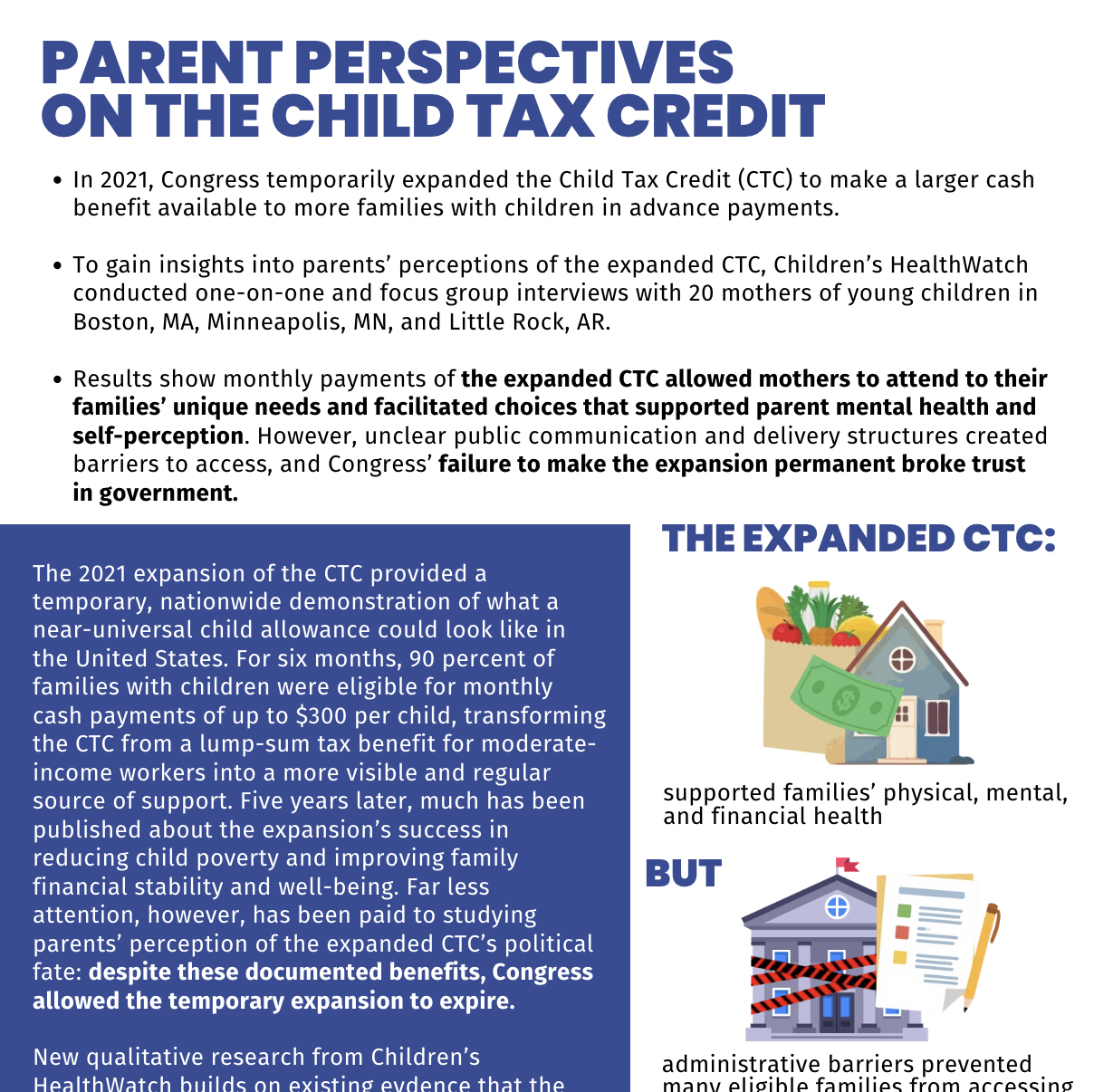
Before the implementation of the advance Child Tax Credit, families experiencing economic shocks were8 times more likely to report food insufficiencythan families who did not have economic shocks.
Families with immigrant parents were 42% less likelyto receive advance Child Tax Credit payments due to multiple barriers.
Advance Child Tax Credit payments that distributed monthly cash payments for children were associated with a 26% reduction in food insufficiency in households with children. After the advance Child Tax Credit expired, there was a 12% increase in food insufficiency in households with children.
Our Research Findings
Housing instability among families with young children is estimated to cost $111 billion in avoidable costs in health care and special education over 10 years.
Families with a history of evictions are 5 times more likely to experience homelessness, 3 to 4 times more likely to experience other forms of housing instability, and more likely to have children in fair or poor health.
1 in 6 children in the United States experienced unstable housing.
Infants from food-insecure families (vulnerable, low-income families with complex needs) who were eligible for rental assistance but did not receive it were more likely to be hospitalized than infants from similar families who did receive rental assistance. Children who experienced cost-driven moves in the past year were more likely to have lost WIC, SNAP, and Medicaid benefits than children who stayed in place.
Our Research Findings
Housing instability among families with young children is estimated to cost $111 billion in avoidable costs in health care and special education over 10 years.
Families with a history of evictions are 5 times more likely to experience homelessness, 3 to 4 times more likely to experience other forms of housing instability, and more likely to have children in fair or poor health.
1 in 6 children in the United States experienced unstable housing.
Infants from food-insecure families (vulnerable, low-income families with complex needs) who were eligible for rental assistance but did not receive it were more likely to be hospitalized than infants from similar families who did receive rental assistance. Children who experienced cost-driven moves in the past year were more likely to have lost WIC, SNAP, and Medicaid benefits than children who stayed in place.
Our Research Findings
Housing instability among families with young children is estimated to cost $111 billion in avoidable costs in health care and special education over 10 years.
Families with a history of evictions are 5 times more likely to experience homelessness, 3 to 4 times more likely to experience other forms of housing instability, and more likely to have children in fair or poor health.
1 in 6 children in the United States experienced unstable housing.
Infants from food-insecure families (vulnerable, low-income families with complex needs) who were eligible for rental assistance but did not receive it were more likely to be hospitalized than infants from similar families who did receive rental assistance. Children who experienced cost-driven moves in the past year were more likely to have lost WIC, SNAP, and Medicaid benefits than children who stayed in place.
Policy Priorities
Children’s HealthWatch research consistently shows that when families are unable to afford basic needs, the health of children and parents suffer. The most simple and effective approach to fight economic inequality and financial instability is to put more money back in the pockets of the people who need it most. In order to alleviate economic hardship and promote the health and well-being of every child and family living in the US, we must actively dismantle systems of institutionalized discrimination and inequity at the root of these hardships, and target the inequitable distribution of wealth and income.
Policies that reduce inequities and promote financial stability for families with children – particularly families of color and immigrant families – are urgently needed to promote health equity. At a time when costs are dramatically increasing due to tariffs, inflation, and cuts to the federal social safety net, policies that promote economic health are more important than ever.
Refundable tax credits, like the Earned Income Tax Credit (EITC) and Child Tax Credit (CTC), are key components of the safety net and one of our country’s most effective tools to alleviate poverty and improve health. Children’s HealthWatch aims to expand these credits on the state and federal level, along with other credits and programs proven to promote economic well-being.
Policy Goals
Pass a permanent, fully refundable, and inclusive Child Tax Credit that ensures all children are eligible for the full credit, including the 19 million children who live in families with incomes too low to qualify.
Restore Child Tax Credit eligibility for children in immigrant and mixed status families, including those with Social Security Numbers and Individual Taxpayer Identification Numbers (ITIN) excluded under the One Big Beautiful Bill Act (OBBBA).
Increase the Child Tax Credit for all children, with a boost for young children.
Allow families to receive the Child Tax Credit in advance payments.
Expand the Earned Income Tax Credit to taxpayers who file using an ITIN.
Reduce structural barriers and promote equitable access to the Child Tax Credit and Earned Income Tax Credit by:
Investing in effective, community-driven outreach efforts;
Providing adequate resources to the Internal Revenue Service (IRS) to improve customer service and operations; and
Restoring Direct File to provide families with a permanent, accessible simplified tax-filing platform available in multiple languages.
Increase the federal minimum wage.
Establish a federal baby bonds program.
Create and expand guaranteed income pilots nationwide.
Establish a minimum tax credit for unpaid caregivers.
Share your thoughts and any of our resources with your members of Congress. Simply call or email them to encourage them to prioritize income stability for the health and well-being of young kids.