

April 3, 2026
To: Speaker Ronald Mariano
Senate President Karen Spilka
Chair Aaron Michlewitz, House Ways and Means Committee
Chair Michael Rodrigues, Senate Ways and Means Committee
Vice Chair Joanne Comerford, Senate Ways and Means Committee
Re: FY27 State Budget: Restore VITA Funding and Expand the EITC to ITIN Workers
Dear Speaker Mariano, Senate President Spilka, and Chairs of the Ways & Means Committee:
On behalf of the Healthy Families Tax Credits Coalition, thank you for the opportunity to submit testimony in support of two opportunities to expand access to refundable tax credits in the Fiscal Year 2027 budget:
- Restore $1.5 million in earmark funding for the Volunteer Income Tax Assistance (VITA) program in line item 1201-0100.
- Expand the Earned Income Tax Credit to immigrant workers who file taxes with an Individual Taxpayer Identification Number (ITIN).
The Healthy Families Tax Credits Coalition is a statewide nonpartisan network of more than 80 community-based organizations, direct service providers, health care institutions, researchers, and advocates working to expand and increase access to state refundable tax credits, including the Earned Income Tax Credit (EITC) and the Child and Family Tax Credit (CFTC).
We are grateful to leadership and the Legislature for its recognition of refundable tax credits as a critical policy tool to deliver relief to families and local economies. Over the past decade, the legislature has expanded eligibility for and generosity of the state EITC, created a $440 CFTC to support the costs of raising and caring for children and other dependents, and allocated state dollars to support the Volunteer Income Tax Assistance (VITA) program – a service that provides free tax preparation services to households with low and moderate incomes.
Refundable tax credits are essential pieces of the social safety net, putting hundreds, or even thousands of dollars in flexible cash back into the pockets of workers and families. This cash helps meet basic needs, advances economic and racial equity, and acts as an economic stimulus for municipalities across our state each tax season.1
While state budgets are tight, the budgets of workers, families, and older adults across our Commonwealth are even more strained. In July of 2025, Congress passed H.R.1, ushering in the largest cuts to SNAP and Medicaid in the programs’ sixty-year history, which will take away benefits from hundreds of thousands of Massachusetts residents.2,3 Additionally, new exclusions of immigrant families from federal benefits, including the federal Child Tax Credit, and increased immigration enforcement has created an environment of intense fear and stress within our communities.4,5 We are also living in an affordability crisis, fueled by structural racism, stagnant wages, and the high costs of housing, health care, child care, and food.6
While no one policy can fully address these intersecting crises, the EITC and CFTC are two existing policies that deliver needed support. However, access to these evidence-based credits is hindered by cuts made to free tax preparation services provided by VITA and the exclusion of immigrant taxpayers in the EITC.
We respectfully request the Massachusetts Legislature restore $1.5 million in earmark funding for VITA in line item 1201-0100 and expand the EITC to immigrant workers who file taxes using an ITIN, evidence-based investments that help meet the moment.
- Restore $1.5 million in earmark funding for VITA in line item 1201-0100
Individuals who made above $15,750 in 2025 and families who earned above $23,625 are required by law to file a federal tax return.7 However, the process of complying with that law is far from straightforward. With the erosion of Direct File8, the Internal Revenue Service (IRS) does not offer a platform to file income tax returns, forcing individuals to navigate a piecemeal and costly tax preparation landscape on their own. Further, families who earn below these thresholds may be eligible for money through the EITC and CFTC, but miss out if they do not file a tax return. In fact, 1 in 5 households eligible for the EITC do not claim the credit, leaving meaningful state and federal dollars on the table.9
The Volunteer Income Tax Assistance (VITA) program is a critical, high-impact program for low- and moderate-income families, workers, and older adults across Massachusetts. Each year, VITA operates more than 80 sites across the state, where IRS-trained volunteers deliver free, high-quality tax preparation services. With a 97% accuracy rate10, these services ensure compliance and help taxpayers claim the full value of tax credits they are entitled to, without the burden of costly fees.
This is in stark contrast to the unregulated, for-profit tax preparation industry.11,12 The US Government Accountability Office estimates that 60% of returns filed by paid preparers contain inaccuracies13, despite fees that can range from $80 to $400 or more.14 For families already under financial strain, these tax preparation fees can significantly reduce a household’s refund.
VITA addresses this by providing free, trustworthy, and accurate services. Sites are often accessibly co-located at community-based organizations and institutions, such as libraries and community action sites, and offer other essential services like financial education and benefits screening. This holistic approach strengthens financial stability beyond tax season.
VITA draws federal dollars into Massachusetts
State investment in VITA delivers an exceptionally high return on investment (60:1),[1]* making the program a fiscally smart strategy, especially in tight budget years. In addition to helping Massachusetts residents fulfill their tax filing obligation and connecting them to state refundable credits, VITA helps residents claim the federal EITC and Child Tax Credit, drawing in significant federal dollars. Eligible families can claim up to $8,046 in federal EITC (average credit of $2,491 among Massachusetts households) and up to $2,200 for each child under the age of 17. State investment in VITA helps bring these federal dollars back into our communities, stimulating economic activity and supporting financial stability at a time when resources are strained.
Continued cuts to VITA harm families, local economy
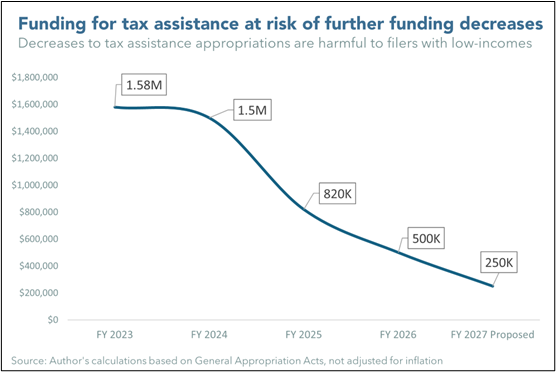
An essential program for Massachusetts residents, line-item support for VITA is critical to maintain site supervision and hours, allowing more families to access its services and state and federal credits.
However, since FY24, state funding for VITA has been reduced by two-thirds.
We urge the Legislature to restore investment to $1.5 million in line item 1201-0100 for FY27 to protect this high-return investment for families and communities across Massachusetts.
- Expand the EITC to immigrant workers who file taxes with an Individual Taxpayer Identification Number (ITIN)
The EITC is a refundable tax credit for workers who earned less than $68,675 in 2025. Established at the federal level in 1975, this credit was created in recognition that hard work alone does not guarantee a person is able to meet their basic needs. The EITC helps boost the income of hardworking families by putting cash back into pockets, delivering an average benefit of $2,491 to Massachusetts families last tax season.15
Decades of research demonstrates that the EITC helps to improve child and family health, advance educational outcomes, and increase economic stability and mobility.16–19 Building on the success of the federal EITC, Massachusetts matches 40 percent of the federal credit – an increase passed by the Legislature in 2023. Last tax season, the state EITC delivered an average $940 to Massachusetts workers.15 However, families who file taxes using an ITIN are ineligible. This creates a large inequity, as both immigrant and US-born workers are subject to the same tax filing obligations.
Since 1996, the IRS has issued ITINs to certain immigrants who are ineligible for a Social Security Number (SSN) so they can comply with US tax law. ITINs are not immigration enforcement tools and do not indicate someone’s immigration status.20 Many immigrants face years of waiting before they can obtain SSNs. The failure of immigration reform at the federal level results in a system riddled with backlogs and dead ends, giving rise to many mixed-status families where some members have SSNs and others do not. Meanwhile, immigrants work, pay taxes, and are integral members of our local economies and communities across the state. The Institute on Taxation and Economic Policy estimates immigrant workers contributed $649M to Massachusetts’ economy in 2024.21 Despite being taxed in the same way as a person with a SSN, ITIN filers and their families are not eligible for many of the tax benefits that U.S. citizens can receive, including the EITC.
Further, entire households are ineligible for the EITC if just one family member has an ITIN. This means that U.S. citizens living in mixed-immigration status households also cannot benefit from the EITC. In Massachusetts, two-thirds of the excluded families, totaling between 14,200 and 17,300 households, are mixed-status, and many of these households include U.S. citizen children.22 If one spouse has a SSN and the other an ITIN, neither they nor their children are eligible for the credit. Now is the moment: support immigrant workers and families
While the federal EITC unfairly excludes workers who file taxes using an ITIN, ten states and the District of Columbia have corrected this inequity in their tax code by extending their state credit to ITIN filers. These include California, Colorado, Illinois, Maryland, Maine, Minnesota, New Mexico, Oregon, Vermont, Washington, and Washington DC. This represents approximately one-third of states with state EITCs.22
The importance of passing immigrant-inclusive policies has been recognized by the Massachusetts Legislature. Expanding access to refundable tax credits, including to ITIN filers, was recommended by the Massachusetts Special Commission to Study Poverty as a recommendation that could help eliminate poverty in the state.23 This recommendation was also included in the Legislature’s Health Equity Task Force final report, A Blueprint for Health Equity.24
In recent years, Massachusetts has enacted legislation to help residents, regardless of immigration status, to take full part in commerce and civic life. Laws providing access to drivers’ licenses and in-state tuition, for instance, have opened opportunities that support employment and advance economic growth.22 The new state CFTC is also available to ITIN filers. The cost of extending the EITC to eligible ITIN holders and their families in the FY27 budget would fall between $22.6 million to $28 million.22
When thinking about how to show support for immigrant communities in this moment, we urge the Legislature to take bold steps forward to pursue equity and increase opportunities for economic mobility through the tax code. Expanding the EITC to immigrant workers is one small action leaders can take to show all communities their work and contributions to our state are celebrated and valued.
Respectfully,
ABCD/Action for Boston Community Development
Alliance of Massachusetts YMCAs
Boston Children’s Hospital
The Boston Foundation
Boston Tax Help Coalition
Brazilian Women’s Group
Brazilian Worker Center
Cambridge Economic Opportunity Committee (CEOC)
CASH MA Coalition
Children’s HealthWatch
Chinese Progressive Association
Community Action Agency of Somerville
Community Economic Development Center, New Bedford
Dragonfly Financial Solutions LLC
ECCHO-Latino
Ellis Early Learning
EMPath
Empowered and Dedicated to Edify the Nation (EDEN)
Food Bank of Western Massachusetts
Fortezela, Inc.
Greater Boston Legal Services
Greater Lawrence Community Action Council, Inc.
Horizons for Homeless Children
Immigrant Service Providers Group/Health
Jewish Alliance for Law and Social Action
Jewish Vocational Services, Boston
La Colaborativa
Massachusetts Association for Community Action (MASSCAP)
Massachusetts Association of Community Development Corporations (MACDC)
Massachusetts Budget & Policy Center
Massachusetts Coalition for the Homeless
Massachusetts Head Start Association
Massachusetts Immigrant and Refugee Advocacy Coalition (MIRA)
Massachusetts Law Reform Institute (MLRI)
Massachusetts Nonprofit Network
Massachusetts Public Health Association
Medical-Legal Partnership Boston (MLPB)
Merrimack Valley Food Bank
Midas Collaborative
National Consumer Law Center
Neighborhood Villages
One Family, Inc.
Project Bread
RESULTS MA
Rian Immigrant Center
Rosie’s Place
Safety Net Project, Legal Services Center of Harvard Law School
SkillWorks
Square One
Strategies for Children
StreetCred
Three Sisters
Together for Kids Coalition
TOOTRiS Child Care On-Demand
Transition House
United Way of Massachusetts Bay
UpTogether
Women’s Money Matters
Worcester Community Action Council
Worcester County Food Bank
YWCA Cambridge
[1]* Each VITA site receives approximately $13,000 from the Massachusetts DOR and Federal IRS to operate. Using round figures, the network of 80 VITA Sites (MassCAP + Boston Tax Help Coalition) together receive about $1 million to cover operating expenses ($1.04M) – that figure, compared to the over $60 million that VITA sites bring to working people through state and federal tax credits equals a 60 to 1 ratio; 60:1 ROI.
Citations
- Holmes N, Berube A. The Earned Income Tax Credit and Community Economic Stability. Brookings Institute; 2015. https://www.brookings.edu/articles/the-earned-income-tax-credit-and-community-economic-stability/
- Healey M, Driscoll K, Department of Transitional Assistance. Governor Healey Calls on President Trump to Continue SNAP Benefits. October 24, 2025. https://www.mass.gov/news/governor-healey-calls-on-president-trump-to-continue-snap-benefits#:~:text=Approximately%20150%2C000%20Massachusetts%20residents%20will,entirely%20over%20the%20next%20year.
- MassHealth. MassHealth Federal Updates and Impact. November 25, 2025. https://www.mass.gov/info-details/masshealth-federal-updates-and-impact#:~:text=We%20estimate%20that%20approximately%20175%2C000,to%20fully%20understand%20the%20policy.
- Children’s HealthWatch Data 2024-2025. Published online. Unpublished.
- Neuman S. ICE is sending a chill through the construction industry. National Public Radio. November 6, 2025. https://www.npr.org/2025/11/06/nx-s1-5575539/ice-immigration-construction-latino-workers
- Stephens H, Perry AM. In Every Corner of the Country, the Middle Class Struggles with Affordability. Brookings Institute; 2025. https://www.brookings.edu/articles/in-every-corner-of-the-country-the-middle-class-struggles-with-affordability/
- Internal Revenue Service. Check if you need to file a tax return. Individual tax filing. January 14, 2026. https://www.irs.gov/individuals/check-if-you-need-to-file-a-tax-return#amount-to-file
- Marr, Chuck. Trump Plan to End Free ‘Direct File’ Program and Rely on For-Profit Tax Preparers Is a Mistake. Off the Charts. December 10, 2025. https://www.cbpp.org/blog/trump-plan-to-end-free-direct-file-program-and-rely-on-for-profit-tax-preparers-is-a-mistake
- Internal Revenue Service. EITC participation rate by state. EITC Partner toolkit. August 21, 2025. https://www.irs.gov/tax-professionals/eitc-central/eitc-participation-rate-by-state
- Internal Revenue Service. Fact Sheet: Quality Statistical Sample Review Results for SPEC Partners and Employees. Department of the Treasury; 2025. https://www.irs.gov/pub/irs-pdf/p5347.pdf
- Singletary M. How a shady tax preparer’s practices can lead to costly IRS trouble. The Washington Post. March 21, 2026. https://www.washingtonpost.com/business/2026/03/21/tax-season-preparer-fraud-errors/
- Hicks J. GAO: Unregulated tax preparers putting taxpayers at risk. The Washington Post. April 21, 2014. https://www.washingtonpost.com/news/federal-eye/wp/2014/04/21/gao-unregulated-tax-preparers-putting-taxpayers-at-risk/
- U.S. Government Accountability Office. Paid Tax Return Preparers: Opportunities Remain to Improve IRS Oversight. 2026. https://www.gao.gov/assets/gao-26-108723.pdf
- Olson NE, Matlock ML, Javonovich E. 2025 Filing Season Mystery Shopping Visits. Center for Taxpayer Rights; 2026. https://taxpayer-rights.org/wp-content/uploads/2026/03/Mystery-Shopping-Report-03-16-26.pdf
- Internal Revenue Service. Statistics for tax returns with the Earned Income Tax Credit (EITC). EITC Partner toolkit. January 16, 2026. https://www.irs.gov/tax-professionals/eitc-central/statistics-for-tax-returns-with-the-earned-income-tax-credit-eitc
- CDC Foundation. Public Health Action Guide: EITC. 2020. https://www.cdcfoundation.org/sites/default/files/files/EITC_PublicHealthActionGuide.pdf
- Hamad R, Dore EC, Wright E, Steedle R, Cowan SK. Economic Policies to Address Poverty as a Fundamental Determinant of Health: Existing Evidence and Future Directions. Annual Review of Public Health. Published online 2025. doi:https://doi.org/10.1146/annurev-publhealth-090924-033323
- Hamad R, Rehkopf DH. Poverty and Child Development: A Longitudinal Study of the Impact of the Earned Income Tax Credit. American Journal of Epidemiology. 2016;183(9):775-784. doi:10.1093/aje/kwv317
- Morgan ER, Hill HD, Mooney SJ, Rivara FP, Rowhani-Rahbar A. State earned income tax credits and general health indicators: A quasi-experimental national study 1993-2016. Health Services Research. 2020;55(S2):863-872. doi:10.1111/1475-6773.13307
- American Immigration Council. The Facts About the Individual Taxpayer Identification Number (ITIN). 2025. https://www.americanimmigrationcouncil.org/wp-content/uploads/2009/06/The-Facts-About-the-Individual-Taxpayer-Identification-Number-ITIN-072025.pdf
- Institute on Taxation and Economic Policy. State and Local Tax Contributions by Undocumented Immigrants. 2024. https://itep.org/undocumented-immigrants-taxes-by-state/
- Baxandall P. Ending the Tax Penalty Against Working Immigrants. Massachusetts Budget & Policy Center; 2024. https://massbudget.org/2024/02/21/itin-eitc-2024/
- Special Commission to Study Poverty. Pathways to Possibility: A Ten Year Roadmap to Expand Economic Mobility in Massachusetts. Commonwealth of Massachusetts; 2025. https://malegislature.gov/Bills/194/SD3122
- Health Equity Task Force. A Blueprint for Healthy Equity. Commonwealth of Massachusetts; 2021. https://malegislature.gov/Commissions/Detail/512/Documents